


The Exam Ends. The Patient’s Need Doesn’t.
A recent LinkedIn discussion asked whether private equity can make ophthalmology better—and who gets to decide what “better” means. I responded with a question of my own: Where does optical fit into that conversation?
That comment has received more than 2,300 impressions. The visibility gives us a reason to keep asking the question.
Across ownership models, optical’s role in completing the patient’s vision care deserves more attention.
What happens after the exam?
Consider a patient who leaves an appointment with an eyeglass prescription. The clinical encounter may be complete, but the patient still needs help turning that prescription into eyewear that works for daily life.
Who explains the options? Who helps the patient understand the cost? Who sets expectations for delivery, checks the fit, and takes responsibility when something needs attention? These are practical service questions. They belong in a discussion about the patient experience.
Patients want answers—and a plan
Patients have ready access to information about their ocular health. They may arrive with questions about ocular surface disease, fluctuating vision, or persistent blurriness. They want to understand what is causing their symptoms, what can be addressed today, and what comes next.
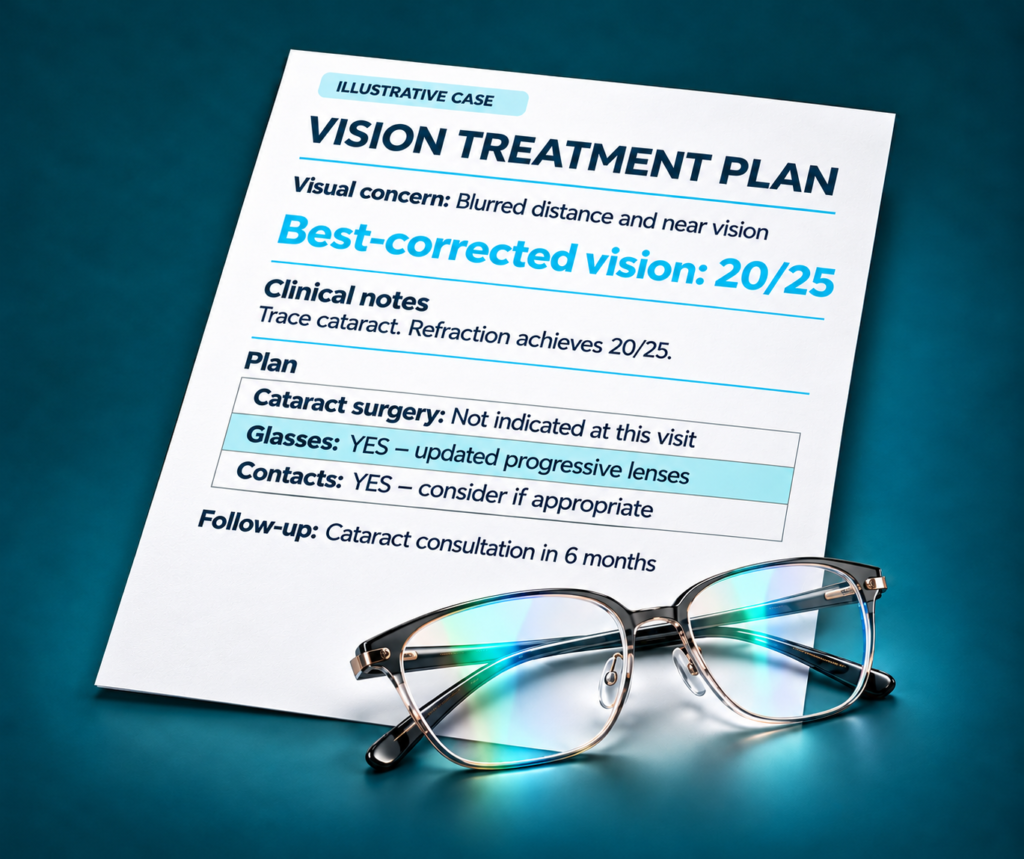
A patient may leave with a plan to monitor a trace cataract and return in six months. Alongside that follow-up, the patient needs to understand how their current visual concerns will be addressed. Depending on the clinician’s findings, the plan may include ocular surface treatment, an updated eyeglass prescription, contact lens evaluation, or further assessment.
A clear explanation and coordinated plan can strengthen patients’ confidence in their care. From their perspective, the measure of care includes how well the practice listens, explains, and follows through on their vision needs.
Optical belongs within that coordinated approach, alongside medical and surgical care, with recommendations guided by clinical findings and daily visual demands. Many practices already do this well; the opportunity is to make that coordination consistent.
Does optical receive the same strategic attention?
Ophthalmic leaders regularly discuss surgical growth, premium IOL conversion, recruiting, technology, and operational efficiency. Those priorities deserve attention. So does the experience of the patient who needs glasses.
Is optical represented in leadership discussions? Does it have trained staff, clear service expectations, and someone accountable for performance? Are leaders reviewing patient concerns alongside collections, costs, and profitability?
Even an established dispensary can benefit from a more deliberate operating strategy.
Bandwidth is a leadership issue
Administrators already balance provider recruitment, staff retention, scheduling, reimbursement pressure, and expanding clinical services. Optical requires its own mix of staffing, training, inventory management, billing, vendor coordination, and patient follow-through.
When responsibility is spread across people with competing demands, optical can struggle to receive consistent attention. The useful question is whether the practice has the expertise, capacity, and accountability to manage it well—and what support would help.
Patient care and financial sustainability belong together
A sustainable optical operation needs financial discipline. It also needs recommendations grounded in the patient’s prescription, lifestyle, preferences, and budget.
The goal should be a service patients can confidently choose: knowledgeable people, appropriate options, transparent pricing, dependable delivery, and support after dispensing. Financial performance should be evaluated alongside those service commitments.
Practices can begin with a few questions: Are patients receiving a clear handoff? Do they understand their options without feeling pressured? Are promised delivery times being met? Are concerns resolved promptly? Does leadership understand the operation’s financial contribution?
A broader definition of “better”
My work with Medical Eyeglass Center centers on helping practices give optical the operational attention it requires. That experience shapes my perspective: optical deserves a place in strategic planning for independent and PE-backed groups alike.
Ownership will remain an important discussion. Within every model, leaders also have an opportunity to examine the services patients rely on after the clinical visit.
As you plan for 2027, is optical receiving the same strategic attention as the other services your patients depend on?
The exam ends. The patient’s need doesn’t.
About the Author
Ron L. Greenberg is Executive Vice President, Client Acquisition & Business Development at Medical Eyeglass Center (MEC), a national optical dispensary management organization serving primarily ophthalmology groups, including leading private equity–backed organizations focused on medical and surgical eye care. MEC helps practices develop sustainable, profitable optical services that support patients’ vision needs while allowing clinical leadership to concentrate on other priorities.