


When Reimbursement Falls, Look Inside the Practice

If you help run an ophthalmology practice, you know the feeling. Costs keep rising. Recruiting is harder. Reimbursement decisions are largely outside your control. Yet physicians and staff are still expected to do more.
A recent Three 13 analysis put that pressure into perspective. It estimated that proposed CY2027 Medicare changes could reduce annual operating profit by approximately $194,000 for a representative practice with four ophthalmologists and two optometrists. The exact impact will differ from one practice to another, but the question is the same: Where will practices find the difference?
The first reaction may be to add more procedures, reduce expenses, or ask the team to work harder. Before doing that, I believe leaders should look closely at an asset they already have: the optical.
An Opportunity Hiding in Plain Sight
Medical Eyeglass Center recently completed six Optical Benchmark Analyses for ophthalmology groups with at least four ophthalmologists and two optometrists. Together, those practices represented 31 optical locations.
The average modeled opportunity was approximately $364,000 in additional annual optical operating profit per practice compared with self-management. The median was approximately $370,500.
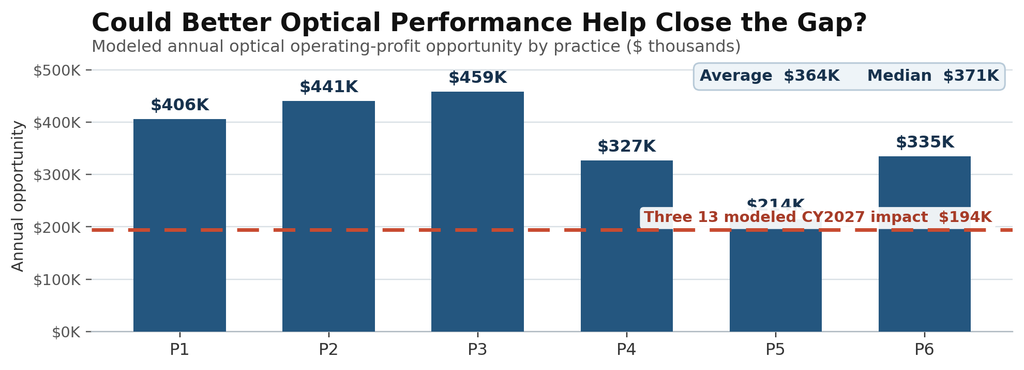
All six modeled optical opportunities exceeded the $194,000 Three 13 reference line.
Why include both numbers? Because the median helps show that one unusually large result did not create the dollar opportunity. In fact, the median was slightly higher than the average. Both figures were close to twice the $194,000 reimbursement impact estimated in the Three 13 model.
These are modeled results based on information supplied by each practice, not promises or guarantees. Actual results depend on execution, staffing, patient volume, payer mix, and local market conditions.
Still, the findings raise an important question:
Could better optical performance help your practice absorb some of the financial pressure ahead?
What practice administrators told us
We recently asked practice administrators to identify the biggest obstacle preventing an optical from reaching its full potential. Their answers were:
- Leadership bandwidth — 38 percent
- Optical expertise — 30 percent
- Staffing and recruiting — 23 percent
- Performance data — 7 percent
At first, these may look like four separate problems. I see them as four parts of the same problem.
When administrators lack bandwidth, the optical receives less attention. Without dedicated expertise, it is harder to know whether the real issue is staffing, product mix, payer participation, pricing, capture rate or workflow. Staffing problems consume even more time, and without useful data, everyone is left managing by instinct.
Performance data received the fewest votes, but it may connect everything else. Data does not run the optical, but it shows leaders where attention is needed and whether changes are working.
Two ways to respond
Practices do not have to choose between improving the optical and growing the clinical business. MEC helps improve the performance of the optical already inside the organization. Three 13 focuses on ongoing growth in the clinical areas at the heart of ophthalmology.
The approaches are complementary. Better optical performance may help make up an immediate financial gap, while a strong clinical growth strategy helps the practice continue growing.
Start with the facts
Not every optical is underperforming, and not every practice needs the same solution. That is why the first step should be an objective benchmark rather than an assumption.
A useful Optical Benchmark Analysis should show leaders where the optical stands today and what realistic alternatives may be available.
Practice administrators cannot control every reimbursement decision. They can control whether existing assets are being measured and managed to their full potential.
Before asking the clinical team to do more, ask whether the optical can do better.
Sources Three 13 analysis • CMS CY2027 proposed rule • MEC OBA benchmark • Eye Don’t Get It administrator poll
MEC figures are modeled from practice-provided data. Individual outcomes will vary.
Contact Ron Greenberg: rgreenberg@medicaleyeglass.net